

Your Pacemaker Can Now Testify Against You and So Can Nearly Anything Else
We Must Rethink Warrants in the Digital Age


We’re increasingly bringing surveillance upon ourselves with the devices we use. These devices are gathering an enormous amount of our data, and this information is readily available for the government to access.
Professor Andrew Guthrie Ferguson tackles the implications of these developments in his new book, Your Data Will Be Used Against You: Policing in the Age of Self-Surveillance.
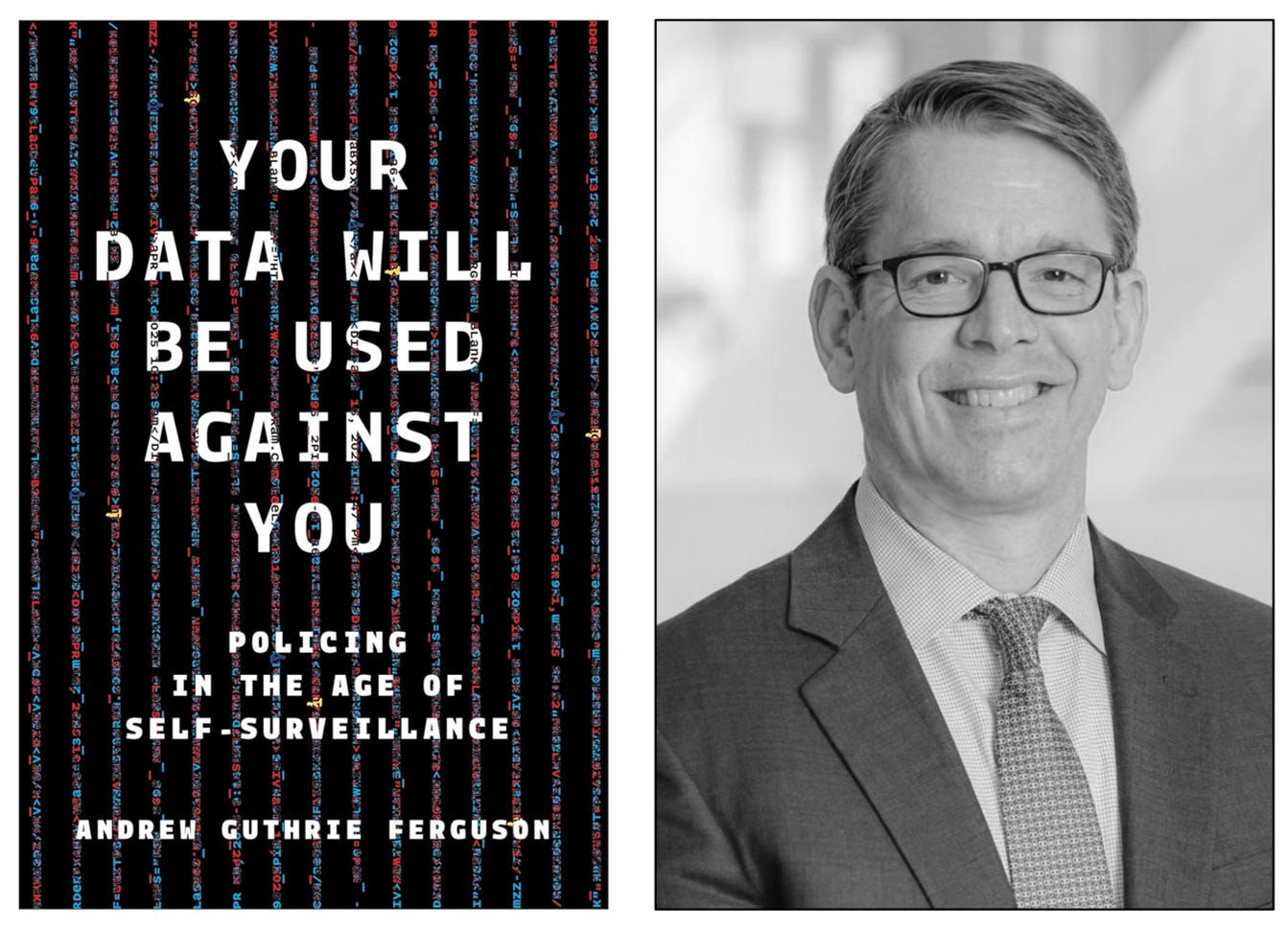
The book is wonderful. It’s highly engaging, accessible, and thought-provoking. Andrew tells stories about real cases and developments that we must reckon with.
I recently discussed Andrew’s book with him in an online interview. You can watch the video below for the full discussion.
One of the highlights was when Andrew spoke about how data from a person’s smart pacemaker was used as evidence against him. Here’s a transcript of some things Andrew said, which I edited lightly:
PROF. FERGUSON: In order for him to survive and do well, he has a pacemaker that is revealing the data in his heart—his heartbeat—and the data goes to him so he can live a healthy life. And it goes to his doctor so his doctor can monitor him. And I think, if you step back, you can say this is the kind of smart technology that we should actually be encouraging. This is the kind of innovation that keeps people alive that is good for society that is the kind of thing that I think we would all promote.
What happened to this gentleman is that his heartbeat was living in a digital file in his doctor’s office that was obtained by police detectives who were investigating an arson. They actually thought it was insurance fraud and that the defendant had burned down his own house to collect the insurance money. They had gone and gotten a warrant to obtain his smart heartbeat to be used against him in a court of law.
To be clear, the detectives were not doing anything wrong. They had a potential crime. They had a recognition that this heartbeat might disprove his story. And in fact, it did. They went and got a document signed by a judge that revealed his heartbeat so the heartbeat could be used against him in court.
The reason why it’s such a great story is that we can agree that this is a good technology. We might also at the same time recognize why there might be need for law enforcement investigation, but at the same time might not want to have our most intimate details—literally our heartbeat—available to be used against us. I think we might rather live in a world where we could have those smart innovations for our health—whether they’re in our hearts or on our wrists or whether they are apps people use to keep track of their menstrual cycle or blood pressure or sugar levels. I would love to be able to keep those things in a world where police could not get access to them even if there was a criminal case they were investigating because of the privacy and intimacy that comes with that data. . . .
Whether it’s your digital diary that you’re writing your deepest dark secrets in, whether it’s your period tracking app and your menstrual cycle written in digital form, whether it’s a data from your smart bed or whether it’s your heartbeat—with a warrant, police can get access to it. This means that everything you create in a digital world—and that’s a lot of things—and almost everything you do is mediated through a digital third party and is available to the police. They can go to that digital third party with a warrant and ask for your data to be used against you.
There literally was no historical parallel. We could not have tracked someone’s heartbeat back in the founding era or even before a few years ago.
Further Reading
Andrew Ferguson, Your Data Will Be Used Against You: Policing in the Age of Self-Surveillance (NYU Press 2026)
Daniel J. Solove, Privacy in Authoritarian Times: Surveillance Capitalism and Government Surveillance, 67 B.C. L. Rev. 51 (2026)
Daniel J. Solove, Nothing To Hide: The False Tradeoff Between Privacy and Security (NYU Press 2011)